


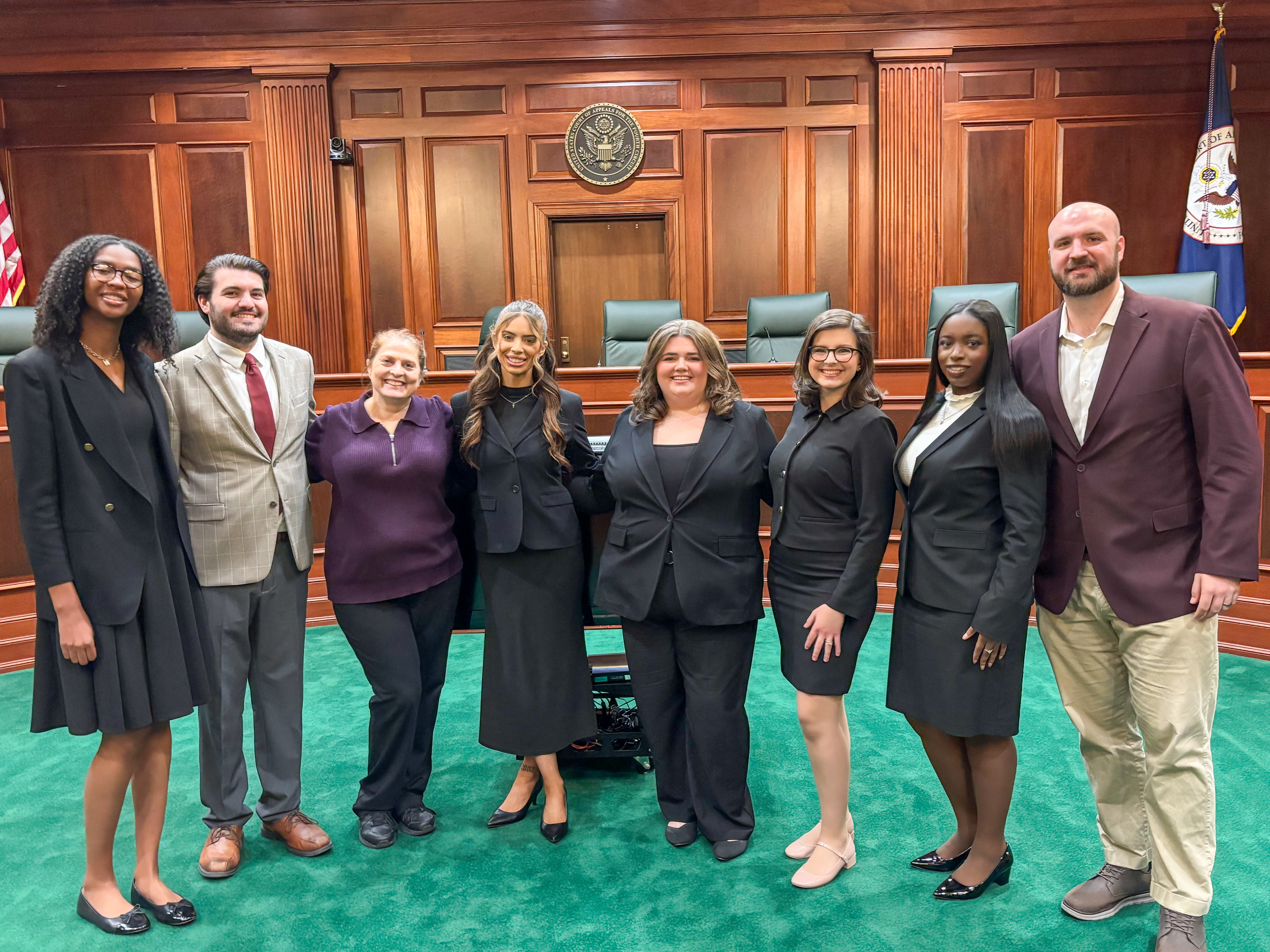
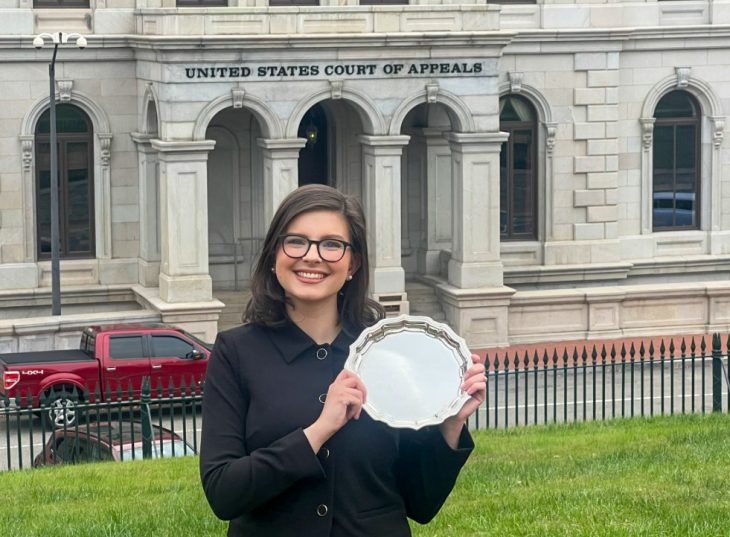
Two Elon Law teams reached the semifinals of the National Moot Court Competition regional tournament, with one capturing the law school's first regional title and earning a trip to New York City in January. Gabrielle Brown Roycroft L’27 also won the Best Advocate award.
Two teams from Elon University School of Law advanced to the semifinals of the National Moot Court Competition regional tournament in Richmond, Virginia, with one capturing the regional championship and qualifying for the national finals in New York City in January 2027.
It is the first time a moot court team from Elon Law has captured the regional championship.
Gabrielle Brown Roycroft L’27, Zaria Hanchell L’27 and Emma Farrell L’26, coached by Elon Law alumnus Preston Edwards L’19, won the regional championship. Roycroft was also named Best Advocate, and the team earned the competition’s third-highest score for its written brief.
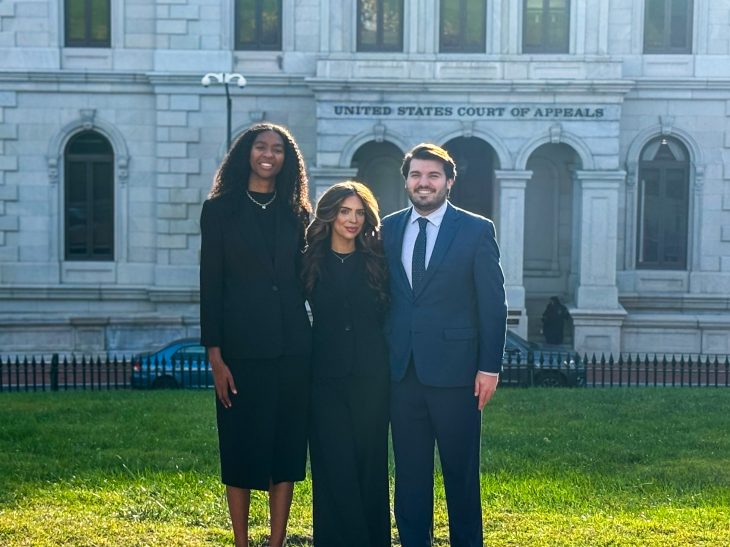
A second Elon Law team composed of Erin Carleton L’26, James Galipeau L’26 and Tyler Sesker L’26, coached by alumna Andrea Davis L’12, reached the semifinals before falling to their Elon Law classmates.
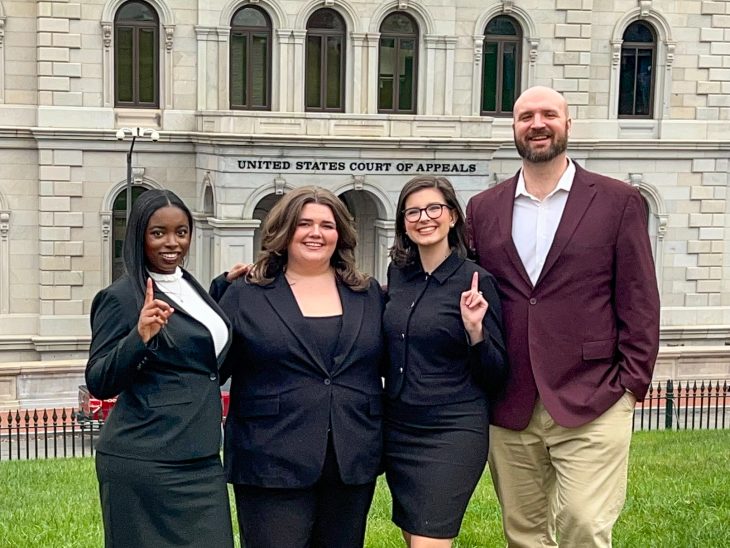
The championship team advances to the 77th annual National Moot Court Competition in New York City in January 2027. Elon Law’s first national competition qualification came in 2021 under the coaching of Vice Dean and Professor of Law Alan Woodlief.
“We couldn’t be prouder of both teams and the way they represented Elon Law,” said Woodlief, director of Elon Law’s Moot Court Program. “Their success reflects months of hard work, careful preparation and outstanding coaching from two of our alumni. To have both teams reach the semifinals, with one going on to win the regional championship and earn a trip to the national finals, is a tremendous accomplishment for them and for our Moot Court Program.”
The National Moot Court Competition, co-sponsored by the New York City Bar Association and the American College of Trial Lawyers, challenges law students to demonstrate their skills in appellate advocacy through written briefs and oral arguments before panels of judges.
For the championship team, preparation involved mastering their arguments without relying on notes, an approach Edwards has emphasized throughout his years coaching Elon Law students. The technique encourages students to engage more directly with judges while demonstrating their command of the case and their advocacy skills.
Edwards, a partner at Triad firm Nixon, Doermann, and Edwards, PLLC who has coached several Elon Law teams to regional semifinal appearances, credited the students’ talent, commitment and willingness to embrace feedback for their success.
“These are three incredibly talented human beings,” Edwards said. “They were committed and sharp, and they became even more impressive as time went on.”
“We stepped out of our comfort zone a lot for this competition by deciding to go without notes from the beginning,” Roycroft said. “Getting critiques is hard but we truly improved leaps and bounds from when we started.”
Hanchell credited the combination of demanding preparation, teamwork and a willingness to improve throughout the competition.
“We consistently sought feedback, implemented it, and discussed different approaches to strengthening our arguments,” she said. “I think the combination of excellent coaching, strong teamwork, and a willingness to continually improve made the difference in our performance.”
Farrell brought an additional perspective to the competition through her judicial residency with Chief Judge Albert Diaz of the U.S. Court of Appeals for the Fourth Circuit. During her residency, she observed appellate advocates in Richmond and gained insight into effective oral advocacy.
“Although initially intimidating, practicing without case notes forced us to truly master our arguments and engage more conversationally with the judges,” Farrell said. “This was an amazing way to close out my 3L year before graduation!”
Among the semifinalists, Sesker credited her teammates and coach with making the semifinalist team’s experience both challenging and memorable.
“Reaching the semifinals reflected the hard work and preparation Erin, James and I put into the competition,” Sesker said. “I couldn’t have asked for better teammates or a better coach. They challenged me throughout the process and made it fun and rewarding.”
The championship team will compete in the national finals in New York City on January 27-29, marking another milestone for Elon Law’s Moot Court Program.